What a 3D iTero Scan Can Do
What a 3D iTero scan can do:
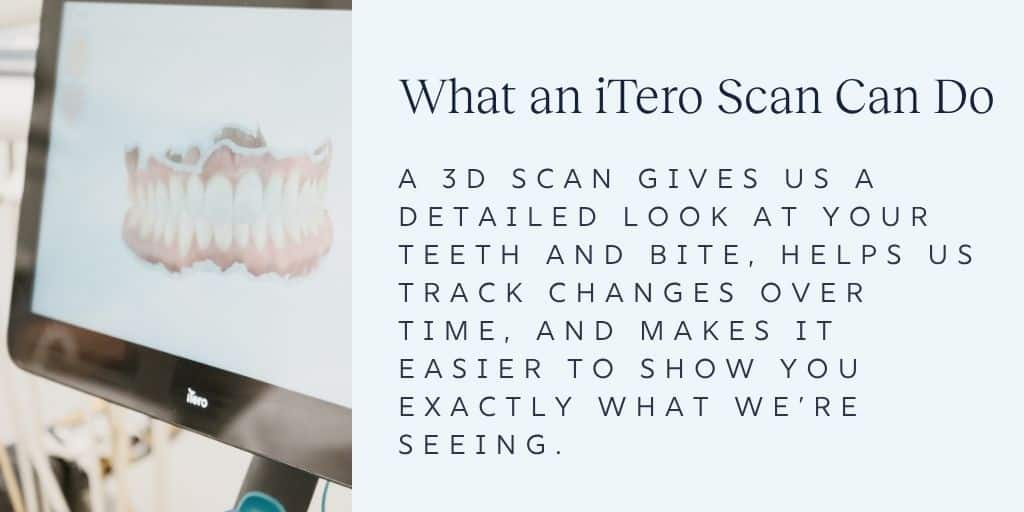
If you’ve had an appointment at CPW Dentistry recently, there’s a good chance you’ve seen an iTero scanner. It’s a handheld scanner that lets us create a detailed 3D model of your teeth in just a few minutes – without using any radiation. Seeing your entire mouth appear on the screen in 3D is neat, but we don’t use an iTero scanner just because the technology is impressive. That digital model can give your dentist useful information about your teeth, your bite, and how things change over time. Just as importantly, it gives us a much easier way to show you what we’re seeing.
What we’re looking at when we scan your teeth:
As we move the scanner around your mouth, it captures images and combines them to create a super-detailed 3D model of your teeth. Your dentist can turn the model around, zoom in, and look at your teeth from different angles to view things like:
- How your teeth fit together: We aren’t only looking at individual teeth. We can also look at your bite and how your upper and lower teeth come together. That information can be useful when we’re evaluating tooth wear, planning restorative work, or considering orthodontic treatment like Invisalign. Sometimes seeing your bite in 3D also makes something that has been difficult to explain make a lot more sense.
- Crowding, spacing, and tooth position: Crowded teeth, spaces between teeth, rotations, and other alignment issues are easy to see on a 3D model. This is one reason we use iTero scans when evaluating patients for Invisalign. The scan gives your dentist a detailed digital record of where your teeth are now and can be used as part of planning how they could move. That doesn’t mean a scan alone can tell us whether Invisalign is right for you. Your dentist still needs to examine your teeth and gums, evaluate your bite and x-rays, and consider your dental history and overall oral health before recommending treatment.
- Changes over time: This might be one of the less obvious benefits of having a digital scan. Once we’ve created a 3D record of your teeth, we have something to compare against in the future. If we take another scan later, your dentist may be able to compare the two to look for changes in things like tooth position or wear. Instead of relying on “I think this looks a little different,” we have an actual record to look back at.
A better way to take impressions:
An iTero scanner can also take a digital impression of your teeth. For certain crowns, restorations, appliances, and other dental treatments, that digital impression can take the place of the traditional, gooey, impression material you may remember biting into. Not every procedure can or should be done from an iTero scan alone, so your dentist will determine what records are appropriate for your treatment.
What else your dentist still needs to see:
This part is important: an iTero scan does not replace a dental exam or dental x-rays. The scanner captures incredibly detailed information about the visible surfaces and position of your teeth. X-rays give us different information, including things we can’t see by looking at the surface of a tooth, as well as information about tooth roots and the bone around your teeth. Your dentist is also evaluating your gums and the other tissues in your mouth during an exam. We use all of those pieces of information together. An iTero scan gives us a better view of certain things, but it doesn’t magically tell us everything that’s happening in your mouth.
The most best part:
The 3D scan generated by the iTero, can be helpful for us, but it’s also helpful for you. Dentistry can be surprisingly hard to explain when we’re talking about conditions in the back of your mouth that you can’t see. With a 3D scan, we can put your teeth right on the screen and look at them together. This is probably our favorite part. It’s one thing for your dentist to tell you that a tooth is wearing down, your bite has changed, or your teeth are crowded in a particular area. It’s another thing entirely when we can turn the screen toward you and show you.We want you to understand what’s happening in your own mouth and why we’re recommending something, whether the recommendation is treatment now, keeping an eye on something, or doing nothing at all. The iTero scanner is another way for us to get good information and share that information with you.
At Central Park West Dentistry, or CPW Dentistry, we use iTero digital scanning when it can give us useful information about a patient’s teeth, bite, or treatment. Our Upper West Side dental office is located at 1881 Broadway, near Columbus Circle.