Skip To Content

Zoom Teeth Whitening | NYC

A brighter smile, done the right way.

Zoom whitening is a professional, in-office treatment that comfortably lifts years of stains from coffee, tea, wine, and time itself in a single visit. At Central Park West Dentistry, our team uses the Philips Zoom! WhiteSpeed system to brighten teeth up to eight shades while protecting the enamel and tissue around them.

Book an appointment

Before we whiten: a healthy smile first

Because believe in clinical integrity above all else, every whitening patient starts with a health check of their teeth and gums so the bright result you walk out with is also a healthy one.

Whitening gel travels through the enamel and into the layer beneath it. That’s exactly why it works — and exactly why we need to know your mouth is healthy before we begin. Untreated cavities, cracked teeth, leaky old fillings, or active gum inflammation can turn a routine whitening into a painful one, and in some cases can damage the tooth long-term. We won’t risk that.

Here’s how that looks in practice:

  • If you’ve had a cleaning, full set of x-rays, and a comprehensive exam in the last three months: we’re happy to schedule your Zoom appointment! If this was done somewhere else, please have your previous office email clinical notes and x-rays to office@cpwdentistry.com and we’ll take it from there.
  • If it’s been longer than three months or you’d prefer to establish care with us: we’ll schedule a new patient visit first: a hygiene cleaning, full series of digital x-rays, and a comprehensive exam with one of our doctors. Your Zoom appointment will then be booked on a separate day, a few days later. That short pause lets your gums settle after the cleaning, so the whitening gel has the most comfortable, even contact with your enamel.

It’s a slightly longer path, but it’s the path we’d take with our own families.

Making the UWS Smile Since '98

Advanced blue LED light-accelerated whitening delivers dramatic results in minimal time.

Zoom WhiteSpeed is a professional in-office whitening treatment that safely lifts stains and discoloration from teeth using a specialized whitening gel and LED light technology. Zoom!® is a registered trademark of Philips.

The Zoom whitening process

  • Either we review records from your dentist within the last three months, or we schedule a cleaning, full x-ray series, and comprehensive exam at CPW first. This is the step some whitening providers skip — but it helps our results hold up.

  • One of our cosmetic dentists reviews your shade goals, photographs your smile, and confirms Zoom is the right fit. If you have sensitivity, gum recession, crowns, or veneers, we’ll talk through how each will respond before we begin.

  • If you’ve had a wellness cleaning recently, we’ll give your gums a few days to calm down before scheduling your whitening. On the day of your whitening visit, we carefully protect your lips, cheeks, and gums with a liquid dam so the whitening gel only touches enamel.

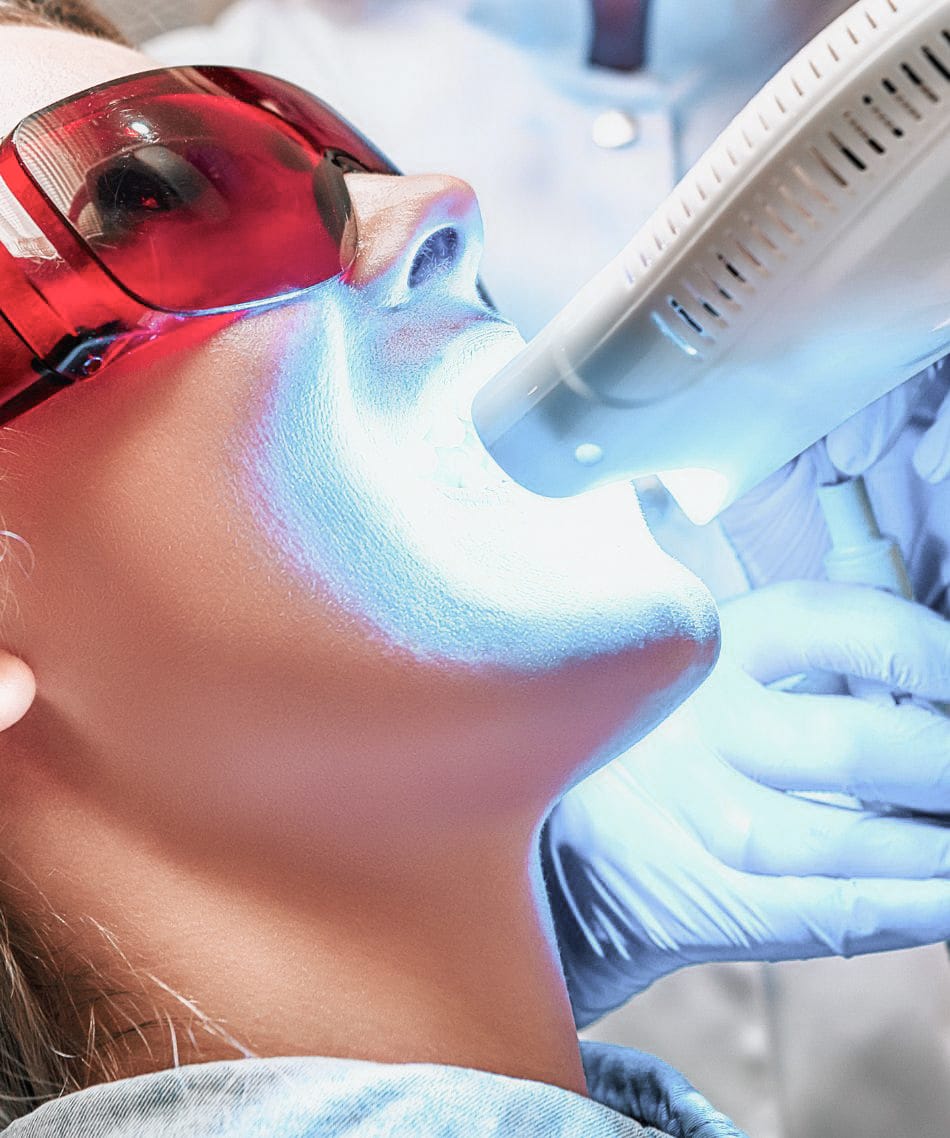
  • Our team applies the hydrogen peroxide gel and activates it with the patented Zoom LED light. The light accelerates the gel, breaking up stain molecules trapped in the enamel.

  • You’ll relax through three 15-minute cycles, each followed by a gel refresh. Stream a show, listen to music, or simply close your eyes — we’ll handle the rest.

  • We compare your before-and-after shade together, then send you home with custom take-home trays and touch-up gel so your results last for months, not weeks.

Zoom Whitening FAQs

  • If you’ve had a cleaning, full set of x-rays, and a comprehensive exam with another dentist within the last three months, yes — send us your records and we’ll get you on the schedule. If not, we’ll schedule a new patient visit (cleaning, x-rays, exam) first, and book your Zoom appointment for a separate day. We know it’s an extra step. We also know it’s the difference between a whitening that works and one that hurts.

  • Whitening gel penetrates the enamel and reaches the dentin layer beneath it. If a tooth has an undetected cavity, a hairline crack, or a worn-out filling that’s no longer sealing, the gel can reach the nerve and cause sharp, lasting pain — and in some cases, real damage. X-rays and an exam let us catch those issues before the gel ever touches your teeth. It’s a 30-minute investment that protects a lifetime of teeth.

  • A professional cleaning does wonderful things for your gums, but it can leave them slightly inflamed for a few days afterward. Whitening gel against irritated gum tissue is uncomfortable and can cause chemical burns or color changes that take days to resolve. Spacing the two visit at least a few days apart lets your gums fully settle, which means a smoother experience and a more even result. It’s the same reason a good colorist won’t bleach your hair the day you’ve had a scalp treatment.

  • Have your previous office email your most recent cleaning notes, full-mouth x-rays (within the last 12 months), and comprehensive exam findings to office@cpwdentistry.com. Most offices can do this within one to two business days. Once we receive and review them, we’ll call you to schedule your Zoom appointment.

  • We use the three-month window because gum health, plaque, and small cavities can change quickly. If you’re just outside that window and your dental history is otherwise stable, give us a call, sometimes our doctors can review your records and make an individual call. When in doubt, we err on the side of doing a fresh exam.

  • Healthy adults whose discoloration comes from food, drink, tobacco, or aging — what dentists call extrinsic and mild intrinsic staining.

  • Final results depend on your starting shade, the type of staining, and how consistently you use your take-home trays afterward.

  • With take-home trays for touch-ups and reasonable habits — morning coffee through a straw, rinsing after red wine, keeping up with cleanings — most patients enjoy their brighter shade for one to three years before considering another in-office session.

  • Zoom is designed to minimize the “zingers” older whitening systems were known for. The WhiteSpeed LED runs cooler than earlier lights, and the gel includes amorphous calcium phosphate to support enamel. Some patients feel mild, temporary sensitivity for 24 to 48 hours afterward.

  • No. Whitening gel only changes the shade of natural tooth structure. If you have visible crowns, veneers, or composite fillings in your smile zone, we’ll discuss the order of treatment. Many patients whiten first, then have restorations matched to the new, brighter shade.

  • For the first 48 hours, stick to a “white diet”: water, milk, chicken, rice, pasta, white fish, cauliflower, plain yogurt. Avoid coffee, tea, red wine, berries, soy sauce, tomato sauce, and tobacco while the enamel pores re-seal.

  • Pricing varies based on whether you combine your whitening with a cleaning, custom take-home trays, or a broader smile makeover. New patients who need a cleaning, x-rays, and exam first will see those itemized separately — we’re transparent about every fee before we begin.

  • Insruance plans consider whitening elective and don’t cover it. However, the cleaning, x-rays, and comprehensive exam portion of your first visit is typically covered like any other preventive appointment. Our front desk is happy to verify your benefits before you come in.

  • Yes — and the earlier you contact us the better. If you’re a new patient, build in time for your initial exam visit plus a few day gap before whitening. We recommend reaching out at least six weeks before any major event so we can sequence everything comfortably.

The science

Whitening can feel like a bit like magic, but it's actually well-understood chemistry that's been studied for more than two decades. Here's what's actually happening inside your enamel when the Zoom gel goes on, and why the details matter for the result you walk out with,

  • What makes teeth yellow in the first place

    Many tooth stains are caused by molecules called chromophores — long, carbon-based molecules with chains of alternating double bonds that absorb visible light and reflect color back to your eye. Coffee tannins, red wine pigments, tea polyphenols, tomato sauce lycopene, and tobacco tar are all chromophores. Over time, they penetrate microscopic spaces within enamel and dentin. Brushing can’t reach them.

  • How hydrogen peroxide actually whitens

    The active ingredient in Zoom is hydrogen peroxide. It’s actually the same molecule, albeit at a different concentration, as what’s in the brown bottle in your medicine cabinet. When it diffuses into enamel and encounters a chromophore, it releases highly reactive oxygen species that break the chromophore’s chain of double bonds, fragmenting it into smaller, lighter molecules that no longer absorb visible light. The tooth itself isn’t being bleached like fabric. Instead, the stain molecules trapped within the tooth are chemically altered.

    Philips Research demonstrated this directly in 2012 by isolating the chemistry from the tooth: they put tea-stain chromophores in a simple solution and tracked how quickly they faded with peroxide alone versus peroxide combined with various accelerators. Two findings stood out. Blue light at 465 nanometers significantly accelerated the reaction. Heat alone did not. Infrared light raised the temperature but didn’t speed up the photochemistry, and excessive heat actually wastes peroxide on unproductive side reactions.¹ This is why the Zoom WhiteSpeed lamp is a blue LED, not a heat lamp. The blue wavelength plays the primary role in accelerating the reaction.

  • Why the LED isn't a gimmick

    There’s been long-standing debate in dentistry about whether activator lights are real chemistry or theater. The honest answer is that it depends on the system. For Zoom WhiteSpeed specifically, the evidence comes down on the side of meaningful, though not unlimited, benefit. In a 2019 randomized split-mouth trial at the University of Texas Health Science Center, 77 adults received 6% hydrogen peroxide on one arch with the Zoom WhiteSpeed LED, and the same gel on the opposing arch without it. Immediately after treatment, the LED side averaged 6.9 shade-guide units of improvement versus 5.3 without (p = 0.0001). At Day 7, the LED side held a 4.4-unit advantage versus 3.6 (p = 0.0089). The benefit was statistically significant on standard shade-guide measurement at every timepoint examined.² One honest caveat we owe you: a second, more sensitive color-measurement instrument used in the same study didn’t find a statistically significant difference between the two sides. The fair conclusion, supported by both readings, is that the light produces a clinically visible improvement on the shade scale dentists actually use.

  • Why a lower-concentration gel with light can outperform a stronger one without

    A common assumption is that more peroxide equals more whitening. The chemistry, and the clinical data, say otherwise: how the peroxide is activated matters as much as how much is in the syringe. In a 2019 study at Loma Linda University’s Center for Dental Research, 136 randomized adults received either Zoom WhiteSpeed (25% hydrogen peroxide with LED) or a competing in-office system (40% hydrogen peroxide, no light). Seven days after treatment, the Zoom group showed a median ΔE color change of 6.34 versus 4.08 for the higher-concentration competitor (p = 0.0059), and a shade-guide reduction of 4.92 versus 4.19 (p = 0.0106).³ In other words, 25% peroxide activated by the right wavelength of blue light produced more whitening than 40% peroxide on its own. For patients who worry about sensitivity, this matters: the LED lets us reach excellent results at a gentler concentration.

  • The "power of three": calcium phosphate, potassium nitrate, and fluoride

    Whitening gel temporarily increases enamel porosity to let the peroxide reach the chromophores. Unprotected, that can leave enamel slightly softer for a short window after treatment. Zoom’s professional take-home formulations include three additives designed to counter that effect:

    Amorphous calcium phosphate (ACP) is a precursor of hydroxyapatite, the mineral your enamel is made of. Delivered alongside whitening, helps supply calcium and phosphate ions that may support remineralization. In a head-to-head microhardness study, a 16% carbamide peroxide gel containing ACP lost only 5.57% of surface hardness, compared to 10.49% for a non-ACP fluoride gel and 11.91% for another fluoride product.⁴ A separate six-month clinical follow-up found that patients using the ACP version retained noticeably more of their whitening result at Day 180 than patients using the same gel without ACP.⁵

    Potassium nitrate is the same active ingredient in sensitivity toothpastes like Sensodyne. It calms nerve activity inside the dentinal tubules, the structures inside your teeth that conduct the cold-water “zingers” people associate with whitening.

    Fluoride reinforces the enamel surface and reduces its susceptibility to acid attack during the brief post-whitening window when the surface is more permeable.

    In the published clinical trials of Zoom WhiteSpeed, the majority of patients reported no sensitivity. In the Loma Linda study, 98.5% reported no sensitivity immediately after treatment, and 82.1% still reported none a week later.³

  • Why take-home trays aren't optional

    Whitening isn’t a one-and-done event chemically. Some color “rebound,” a small darkening as enamel rehydrates and stain begins to redeposit, is normal in the days and weeks after an in-office session. The published Zoom WhiteSpeed protocol therefore pairs the chairside treatment with a short course of take-home carbamide peroxide gel, a slower-releasing form of peroxide that’s gentle enough for overnight use. In the 2019 Texas trial, adding three overnight take-home doses after the in-office visit measurably maintained the color improvement two weeks out.² This is the part some same-day whitening offers skip.

  • References

    1)Young N, Fairley P, Mohan V, Jumeaux C. The chemistry behind hydrogen peroxide tooth whitening. J Dent Res 2012;91(Spec Iss B):147. Philips Research Laboratories, Cambridge, UK.

    2)Ontiveros J, Eldiwany MS, Arriaga DM, et al. Clinical efficacy & sensitivity on in-office tooth whitening with & without light treatment combined with at-home bleaching. J Cosmetic Dent 2019;34(4):70-79. University of Texas Health Science Center School of Dentistry, Houston.

    3)Lee SS, Kwon SR, Ward M, Jenkins W, Souza S, Li Y. A 3-month clinical evaluation comparing two professional bleaching systems of 25% and 40% hydrogen peroxide and extended treatment outcome using a power versus a manual toothbrush. J Esthet Restor Dent 2019 Mar;31(2):124-131. Loma Linda University Center for Dental Research.

    4)Sung EC, Chung J, Chung EM, Caputo AA. Effect of take-home whitening agent on enamel microhardness. J Dent Res 2007;86(Spec Iss A):1769.

    5)Giniger M, Spaid M, MacDonald J, Felix H. A 180-day clinical investigation of the tooth whitening efficacy of a bleaching gel with added amorphous calcium phosphate. J Clin Dent 2005;16:11-16.